
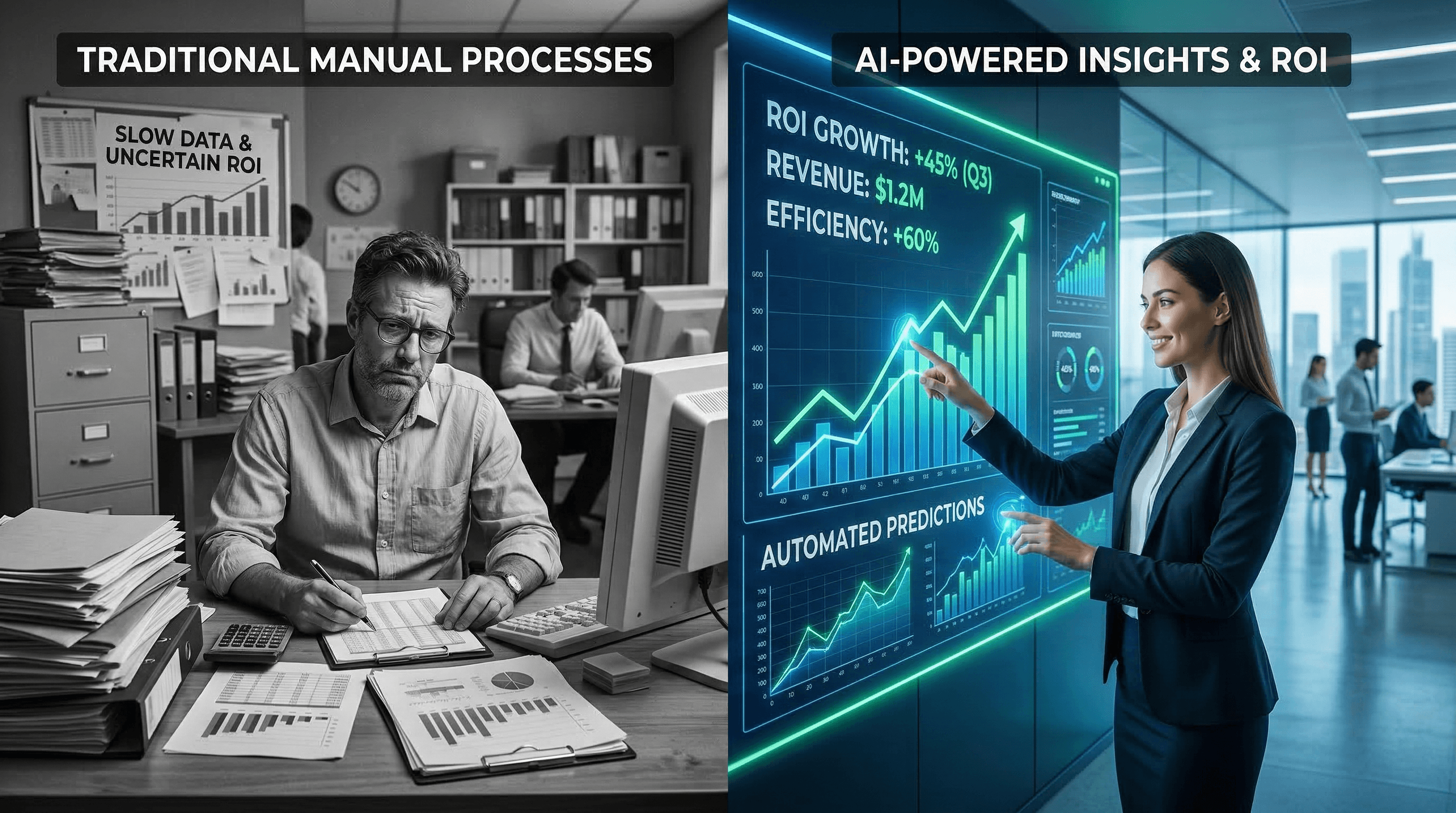
Moving Beyond Hype: Measuring AI's Business Impact
Every technology vendor promises transformative results. What distinguishes AI agent implementations from previous technology waves is the speed and clarity with which results can be measured. Unlike broad digital transformation initiatives that take years to show returns, AI agent deployments typically demonstrate measurable ROI within 8-12 weeks.
This article presents concrete data from AI implementations across Swiss industries. The numbers are aggregated and anonymized, but they represent real outcomes from real deployments.
The Financial Framework
Before examining specific cases, it is important to understand the cost components of an AI agent implementation:
Investment Components
- Platform licensing -- The AI agent infrastructure and tools
- Integration development -- Connecting agents to existing systems (ERP, CRM, databases)
- Training and configuration -- Teaching agents your specific business processes and rules
- Change management -- Preparing your team to work alongside AI agents
- Ongoing optimization -- Continuous improvement based on performance data
Return Components
- Labor cost reduction -- Staff redeployed from routine tasks to higher-value work
- Error reduction -- Fewer mistakes, less rework, lower compliance risk
- Speed improvement -- Faster processing means faster revenue recognition and better customer satisfaction
- Capacity increase -- Handle more volume without proportional cost increases
- Revenue uplift -- Better customer experience and faster response times drive growth
Case Studies: Swiss Companies, Real Numbers
Case 1: Mid-Size Insurance Company (Zurich)
Challenge: Processing insurance claims required an average of 12 days, involving manual document review, policy verification, and multi-department approvals.
Solution: Deployed three orchestrated AI agents for document extraction, policy matching, and decision recommendation.
Results after 6 months:
- Average claim processing time: 12 days reduced to 2.5 days (79% improvement)
- Processing cost per claim: CHF 145 reduced to CHF 38 (74% reduction)
- Customer satisfaction score: Increased from 3.2 to 4.6 out of 5
- Staff redeployed to complex cases: 8 FTEs, improving outcomes for high-value claims
- Annual savings: CHF 1.2 million on a CHF 340,000 implementation investment
- ROI: 253% in year one
Case 2: Professional Services Firm (Geneva)
Challenge: Consultants spent 30-40% of their time on administrative tasks: time tracking, report generation, client communication, and project status updates.
Solution: Deployed AI agents for automated time capture, report drafting, meeting summarization, and project status aggregation.
Results after 4 months:
- Administrative time per consultant: Reduced from 35% to 12% of working hours
- Billable hours per consultant: Increased by 23%
- Report generation time: From 4 hours to 20 minutes
- Client communication response time: From 24 hours average to 2 hours
- Revenue increase per consultant: CHF 47,000 annually
- For a team of 25 consultants: CHF 1.175 million in additional annual revenue
- ROI: 312% in year one
Case 3: E-Commerce Retailer (Bern)
Challenge: Customer support team overwhelmed with routine inquiries across German, French, and Italian. Average response time exceeded 8 hours.
Solution: AI agent handling first-line customer support with automatic language detection and seamless escalation to human agents for complex issues.
Results after 3 months:
- Inquiries handled autonomously: 72% (no human intervention needed)
- Average response time: 8 hours reduced to 3 minutes for AI-handled inquiries
- Customer satisfaction: Maintained at 4.3/5 (comparable to human agents at 4.4/5)
- Support team capacity: Effectively tripled without hiring
- Cost per resolved inquiry: CHF 8.50 reduced to CHF 1.20
- Annual savings: CHF 520,000 on a CHF 180,000 implementation
- ROI: 189% in year one
Case 4: Manufacturing Company (Aargau)
Challenge: Quality control relied on manual inspection, catching defects late in the production process.
Solution: AI agent monitoring production line data in real-time, predicting quality issues before they occur, and automatically adjusting parameters.
Results after 8 months:
- Defect rate: Reduced from 3.2% to 0.8%
- Material waste: Reduced by 28%
- Unplanned downtime: Reduced by 45%
- Production throughput: Increased by 12%
- Annual savings: CHF 890,000 on a CHF 420,000 implementation
- ROI: 112% in year one, projected 340% by year two
Patterns Across Implementations
Analyzing dozens of deployments reveals consistent patterns:
Time to First Value
- Simple automation (document processing, data entry): 4-6 weeks
- Customer-facing agents (support, sales assistance): 6-10 weeks
- Complex orchestration (multi-department workflows): 10-16 weeks
Typical ROI Ranges by Use Case
- Customer support automation: 150-300% year-one ROI
- Document processing: 200-400% year-one ROI
- Sales and marketing assistance: 100-250% year-one ROI
- Operational optimization: 100-200% year-one ROI
Common Success Factors
- Clear baseline metrics established before deployment
- Executive sponsorship ensuring organizational alignment
- Focused scope for initial deployment, expanding based on results
- Integration quality with existing systems and data sources
- Change management preparing teams for new ways of working
What Determines ROI Magnitude
Three factors most strongly predict the magnitude of returns:
- Process volume -- Higher-volume processes yield larger absolute savings
- Current cost per transaction -- More expensive manual processes show greater per-unit improvement
- Error sensitivity -- Industries where errors are costly (finance, healthcare, legal) see amplified returns from accuracy improvements
Building Your Business Case
To build a credible business case for AI agent implementation:
- Quantify current state -- Measure time, cost, error rate, and volume for target processes
- Estimate conservative improvements -- Use 60-70% of benchmark figures for initial projections
- Include all costs -- Platform, integration, training, change management, and ongoing optimization
- Plan for phased deployment -- Show value at each stage rather than requiring full investment upfront
- Define success metrics -- Agree on what will be measured and how before implementation begins
Next Steps
SWISS.Ai offers complimentary ROI assessments for Swiss businesses considering AI agent implementation. Our team will analyze your specific processes, estimate potential returns using our benchmark data, and provide a detailed implementation roadmap. The assessment typically takes 2-3 hours and delivers a clear picture of where AI agents can drive the most value for your organization. Contact us to schedule your assessment.